

Planning corporate training or e-learning videos in Dubai? This guide covers formats, process, and what makes training content actually work.
A live event only reaches the people in the room, unless it’s broadcast to everyone who couldn’t be there. Live broadcast services Dubai work has become essential for conferences, product launches, and corporate events that need to reach a global or remote audience in real time, not just document the event after the fact.
For event organizers and corporate teams planning their first livestream, the gap between “point a camera at the stage” and a genuinely professional broadcast is bigger than it looks.
This guide breaks down what live broadcast production actually involves, the technical requirements behind a reliable stream, and what separates a smooth broadcast from one
that drops out halfway through the keynote.
What a Live Streaming Company Dubai Actually Delivers
A Live Streaming Company Dubai brings together production, technical, and platform expertise to turn a physical event into a reliable, professional-quality live broadcast. This goes well beyond simply pointing a camera at a stage. A full live broadcast service typically covers:
● Multi-camera coverage capturing different angles of the stage, audience, and any presentation screens.
● Live video switching, cutting between camera angles and content in real time as the event unfolds.
● Audio mixing, ensuring microphones, presentation audio, and ambient sound blend cleanly for remote viewers.
● Encoding and platform delivery, converting the live feed into a format that streams reliably to the chosen platform.
● Redundancy planning, building in backup systems so a single point of failure doesn’t take the entire broadcast offline.
Event Live Broadcast Production UAE: How It’s Technically Different From Recorded Video
Event Live Broadcast Production UAE work carries technical demands that standard event videography doesn’t, because there’s no opportunity to fix a mistake in post-production. Everything has to work correctly in real time.
This changes several production priorities:
● Redundancy matters more than almost anything else. Backup internet connections, backup power, and backup recording are standard practice for professional live broadcast, since a single failure is visible to the entire live audience instantly.
● Real-time decision-making replaces editing. A live switcher operator makes camera and content decisions in the moment, requiring more experienced crew than a standard recorded shoot.
● Bandwidth and encoding have to be planned in advance. Streaming quality depends directly on stable upload bandwidth at the venue, which needs to be tested and confirmed well before the event, not discovered as a problem on the day.


Corporate Event Streaming Dubai: Common Use Cases
Corporate Event Streaming Dubai spans a wide range of formats, each with slightly different production needs.
Conferences and Summits
Multi-day events with multiple stages or breakout sessions often require the most complex broadcast setups, sometimes streaming several sessions simultaneously to different audience segments.
Product Launches
Product launches typically combine live broadcast with more cinematic production values, since brand presentation quality matters as much as technical reliability for this kind of high-visibility event.
Town Halls and Internal Communications
Internal corporate broadcasts, such as company-wide town halls, generally prioritize clear audio and reliable delivery over elaborate production value, though the stakes for reliability remain just as high given the internal audience watching live.
Award Ceremonies and Galas
These events often require more elaborate multi-camera coverage and lighting coordination, closer in production complexity to a televised broadcast than a standard corporate stream.
Multi-Camera Live Production Dubai: How Coverage Actually Works
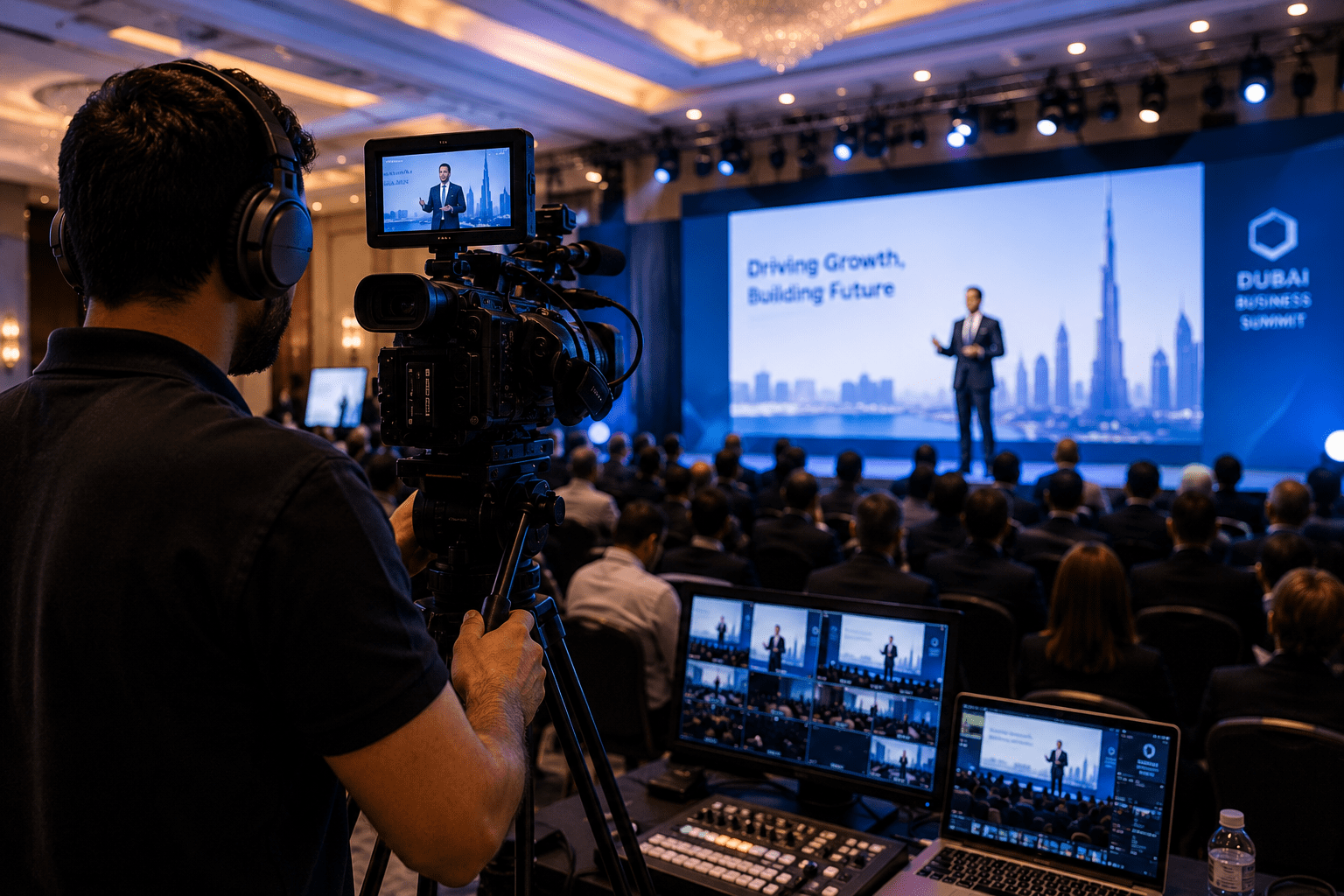
Multi-Camera Live Production Dubai relies on several cameras capturing different angles simultaneously, fed into a live switcher that allows a director to cut between shots in real time, much like a television broadcast. Typical camera positions include:
● A wide shot capturing the full stage for context.
● A tighter shot on the primary speaker or presenter.
● A dedicated feed for any presentation slides or screen content.
● Audience reaction shots, when relevant to the event format.
The switching decisions happening live are what separate a professional broadcast from a single static camera feed, keeping remote viewers engaged the way a well-edited video would, but happening in real time rather than in post-production.
Live Event Video Production Dubai: Planning for Both Live and Recorded Use
Live Event Video Production Dubai projects often need to serve two purposes at once: the live broadcast itself, and a polished recorded version for later use in marketing or archival content. Planning for this dual purpose during pre-production, including camera positioning and audio setup that works for both immediate streaming and later editing, avoids having to
choose between broadcast quality and post-event content value. This overlaps with broader pre-production planning principles covered in this guide on pre-production planning for commercial films, applied specifically to the live event context.
Webcast Production Company Dubai: Platform and Delivery Considerations
A Webcast Production Company Dubai needs to account for where the stream will actually be watched, since delivery requirements differ across platforms.
● YouTube and social platforms generally require different encoding settings and bitrates than dedicated webcast or webinar platforms.
● LinkedIn Live and similar professional platforms often suit corporate and B2B events, aligning with broader platform-specific content strategy covered in this guide on LinkedIn video content production.
● Custom or private platforms are common for internal corporate broadcasts or ticketed virtual events, requiring integration testing well before the live event itself.
Live Streaming Equipment Dubai: What a Professional Setup Requires
Live Streaming Equipment Dubai for a professional broadcast typically includes multiple broadcast-grade cameras, a video switcher for live camera cutting, audio mixing equipment, encoding hardware or software to prepare the feed for streaming, and redundant internet connections to protect against connectivity failure. The specific equipment scale depends heavily on event size and complexity, but redundancy planning, having backup systems for the most failure-prone components, should be standard regardless of event scale.
Conference Live Streaming UAE: Managing Multi-Session Complexity
Conference Live Streaming UAE work for larger events often needs to manage multiple simultaneous sessions, particularly for conferences with breakout tracks running in parallel. This requires more extensive crew and technical planning than a single-stage event, including coordinating multiple switching setups and ensuring each stream has independent redundancy rather than sharing a single point of failure across the entire event.
Hybrid Event Broadcast Dubai: Serving In-Person and Remote Audiences Together
Hybrid Event Broadcast Dubai has become increasingly common, requiring production planning that genuinely serves both audiences rather than treating the livestream as an afterthought to the in-person experience. This often means considering camera angles and audio mixing specifically for the remote viewing experience, not just capturing what’s visible from the back of the room, along with planning for remote audience interaction, such as live Q&A integration, where relevant.
Choosing a Live Broadcast Company for Events Dubai
When evaluating a Live Broadcast Company for Events Dubai, a few signals separate studios genuinely equipped for live production from those better suited to standard recorded event coverage:
● Demonstrated redundancy planning, with clear answers about backup systems for internet, power, and recording.
● Experience with your specific event type, since a conference broadcast and a product launch broadcast require different production approaches.
● Platform delivery expertise, confirming they’ve successfully delivered to your intended streaming platform before.
● Clear technical rehearsal process, testing bandwidth, audio, and switching setups before the actual event, not during it.
Panda Creations’ event and broadcast services cover this full scope, from multi-camera live production through platform delivery for corporate and public events across Dubai. This guide on how to choose a video production company in Dubai also covers broader vendor evaluation criteria worth applying to live broadcast specifically.
FREQUENTLY ASKED QUESTIONS
What internet bandwidth is needed for a professional livestream?
Bandwidth requirements scale with video quality and the number of simultaneous streams, but a stable,
tested upload connection with backup redundancy is essential regardless of event size, since connectivity issues are the most common cause of live broadcast failures.
What’s the difference between a livestream and a hybrid event?
A livestream simply broadcasts an event to remote viewers, while a hybrid event is specifically designed to serve in-person and remote audiences as equally engaged participants, often including remote
interaction features like live Q&A.
How many cameras are typically needed for a corporate event livestream?
This depends on event complexity, but most professional corporate broadcasts use at least two to
three cameras, a wide stage shot, a presenter close-up, and a dedicated feed for any presentation content.
Can a livestream also produce a polished recorded video for later use?
Yes, when planned during pre-production. Camera positioning and audio setup can be designed to
serve both the live broadcast and a higher-quality edited version for later marketing or archival use.
What happens if the internet connection fails during a live broadcast?
Professional live broadcast setups typically include backup internet connections and redundant recording, so a primary connection failure can be managed without losing the stream entirely, provided redundancy was planned in advance.
Bandwidth requirements scale with video quality and the number of simultaneous streams, but a stable,
tested upload connection with backup redundancy is essential regardless of event size, since connectivity issues are the most common cause of live broadcast failures.
A livestream simply broadcasts an event to remote viewers, while a hybrid event is specifically designed to serve in-person and remote audiences as equally engaged participants, often including remote
interaction features like live Q&A.
This depends on event complexity, but most professional corporate broadcasts use at least two to
three cameras, a wide stage shot, a presenter close-up, and a dedicated feed for any presentation content.
Yes, when planned during pre-production. Camera positioning and audio setup can be designed to
serve both the live broadcast and a higher-quality edited version for later marketing or archival use.
Professional live broadcast setups typically include backup internet connections and redundant recording, so a primary connection failure can be managed without losing the stream entirely, provided redundancy was planned in advance.
Gallery


A successful live broadcast comes down to technical reliability as much as production
quality, since there’s no opportunity to fix a mistake after the fact. Planning redundancy, testing platform delivery, and working with a crew experienced in real-time production decisions is what separates a professional stream from a risky one. If you’re planning an event that needs to reach a global or remote audience, you can start a project with Panda Creations directly.
View more interesting topics
Tab 1
Tab 2
Tab 3

admin
AuthorThank you for reading. Explore more articles from our blog.